We keep people informed on latest tech news and inventions around the world. We are reliable and updated on latest happenings in the world of technology.
Thursday, April 11, 2019
Palm’s back into the fold, being brought back to life after Chinese maker TCL, the same company that bought the rights to manufacture BlackBerry smartphones, purchased the Palm trademark from HP back in 2014. Even though the brand has been resurrected, this is a totally different Palm from the one we all remember that helped bring PDAs (Personal Digital Assistants) into the market during the 1990s, and subsequently being one of the major smartphone powers in the early days of the 2000s.
This new Palm is young, hip, and ready to tackle the market from a totally different perspective. With the announcement of the aptly named Palm Phone, they’ve taken many of us by surprise! Rather than tangling with the heavy hitters in the space, the Palm Phone is intended to act as a companion – much like how smartwatches aim to keep us connected, while remaining secondary to our smartphones. Needless to say, it’s an interesting new strategy for Palm, but does it effectively get the job done?
In the box:
Palm Phone
Wall/USB Charger
USB Connector
Quick Start Guide
Product Safety & Warranty Brochure
Design
This new Palm is forging a new design identity, seeing that this Palm Phone shares no characteristics from past Palm smartphones. As you can imagine, it’s etching out its own identity in the process due to its unconventional size. Speaking of that, the minuscule size of the Palm Phone is the first thing that stands out! It’s obnoxiously tiny, just about the length and width of a credit card. Combined with its lightweight frame, the Palm Phone easily slips into any pocket discretely!
Due to its shrunken size, however, most people will need to readjust their habits when it comes to handling and operating it. Take for example holding the phone with our hand, which requires no more than a few fingers to do. Since space is rather limited, the Palm Phone only features a single power button – so volume adjustment is handled through the software by accessing it in the pull-down menu. Yes, it’s a hassle, but at least we can quickly silence incoming phone calls by pressing on the power button.
As I walked into the chaotic registration zone at the hall hosting Xiaomi’s press conference, my first event of the 2019 Mobile World Congress (MWC), I soon became aware that I looked… different.
I was dressed reasonably smartly and was even dutifully wearing my delegate's lanyard just like everybody else, even though I hate it – it is too long and I had to tie a knot in it when I realised people were not admiring my belt but trying to read my name.
But, in the sea of people milling around awkwardly, waiting to collect a pass giving them access to the event, my colleague Tracey and I were two of very few women.
It was a woman who gave me my pass. It was also a woman who was pouring out glasses of wine for the reception afterwards. But there were no women speaking inside the hall during the presentation.
We left in a hurry to go to another event across town, hosted by Huawei, the brand everybody is talking about both here in Barcelona and around the world.
Once there, I looked at the long queue snaking round outside the beautiful Italian Pavilion in the heart of Barcelona. I was once again in the minority. Inside, there were no women on stage here either.
I shared a taxi to the next event with analyst Carolina Milanesi, who travels the world attending technology industry events such as MWC. It was the same every year, she told me as we chatted.
“At CES [the Las Vegas technology fair], the thing was booth babes and skimpily dressed people – that’s not the case here but women are in the position of being the hostess, they are smart and look nice but they are serving,” she told me.
“You are either sexually objectified or you are the housewife but you are not seen as making a decision about tech or buying it.”
Image captionThe conference halls are also full of men
At my final event of the day, hosted by Microsoft, the organisers had clearly tried to even out the presenters, alternating men and women – although after the first four speakers, there was a succession of men before the next woman joined the stage.
On day one of the exhibition itself, I spent an hour in the priority queue to try out Microsoft’s HoloLens2. Not only was I the only woman in that queue, there were only a tiny handful in the enormous, general queue, which, I heard, was four hours long. The security guard at the front was a woman.
Around the conference halls, I found myself constantly jostled by crowds of men swarming around concept cars, robots and 5G smartphones. Meanwhile, the press officers who were constantly pinging me on email, asking me to meet their exhibiting clients were more likely to be women than men.
Claire, not her real name, is attending MWC for the first time, working for one of the major global brands.
“I have to say I am surprised by how few women there are at the event - barring of course hospitality and venue staff,” she told me
“I thought that this should be different [to other industry events] - it's much more consumer focused - but a common theme among the women I've met here is the fact that the halls are a sea of testosterone.”
She thinks some technology companies need to rethink their priorities.
Image copyrightEPAImage captionMen queue up to take a picture of Huawei's foldable phone
“The industry talks a good game about being relevant to women - but it's hard to believe that for some companies it's anything more than lip service when you look around the hall,” she said.
One company under scrutiny for many reasons already is Huawei, which has a huge presence here.
In one hall, it occupies a vast space, easily the size of a supermarket. And every single delegate's lanyard bears the Huawei logo.
We arrived before its stand opened but waiting to greet people when it did were women dressed in national costumes from around the world.
Thankfully, there were no bikinis but still I couldn’t quite decide whether this was a beautiful display of global inclusivity or a cringeworthy homage to Miss World.
The million dollar question here of course is – why aren’t there more women here? It’s not like female attendees are screened out. If you’ve got the 450 euros, and/or press or analyst credentials, you can come.
A spokesman for the Global System for Mobile Communications trade body, which organises MWC, told me that in 2018 24% of the delegates had been women, a 1% increase on 2017. Over 100,000 people attend.
He also told me about the Women4Tech programme, which runs a number of events aimed at women working in and around the industry during the four days of MWC.
I love tech, I have spent years covering the subject as a journalist and I don’t feel my gender prevents me from doing so. It’s very rare that I feel actively unwelcome at an event – I don’t here either - and the days when people used to ask me who was looking after my children while I was working seem, fortunately, to be behind me.
It’s more subtle than that - and not necessarily a conscious bias. Perhaps it’s a vicious cycle - women like me come along, feel a bit like we should be serving the drinks and then decide not to return. We have to shout louder, jostle harder, raise our arms higher to get those photos.
The men I have spoken to about it seem a bit embarrassed. The women seem resigned.
An industry friend of mine told me it was one reason why she chose to avoid these events.
Don’t forget, though, that women are equally expected to consume all of this technology. And if we disappear, our voices will not be heard when it comes to their design.
Here’s an example of what I mean.
At a networking event one evening, I chatted to the owner of a mobile phone company over a glass of wine. We were discussing the new trend for folding phones. And I said I would prefer one that folded out to be the size my existing phone is now.
He asked me why on Earth that was the case, so I showed him how awkwardly it fits into the pockets of my jeans. And he was absolutely astonished.
His fitted just fine, he said - he’d never even thought about it.
Every day, thousands of Internet users fall for silly hoaxes and transparent scams. Why?
Many commentators suggest that all of the people who fall for such scams and hoaxes are just plain stupid. But, this is not true.
I’ve been working in the hoax and scam debunking field for more than fifteen years and during that time I’ve talked to a great many people who have been scammed or who have fallen for silly hoaxes. And, I can assure you that they are not always stupid. Many are smart, articulate, and well-educated.
So why do otherwise smart people fall for obvious scams and hoaxes? There is perhaps no clear and definitive answer, but here are a few ideas.
People Click Before They Think
The immediacy of social media and the Internet is one of its strengths. But, it can also be one of its problems.
You can like or share something in an instant. One click can take you to a dangerous website or open a malware attachment. In the blink of an eye, you can like and share a silly fake-news report that you’ve just glanced at, which promotes it across your networks.
Everything online seems to hurtle along at a frenetic pace. It’s easy for people to get caught in the moment and click away when ideally, they should have stepped back and more closely analysed what they are reading. Applied some critical thinking, perhaps.
Information Overload
Hand in glove with the immediacy issue I discuss above goes information overload. These days, we are bombarded with information from many different directions at once. Email, blogs, forums, text messages, and, of course, continually updated social media feeds on Facebook, Twitter and other social networks.
And we receive an eclectic mix of many different types of information. Serious news and website articles, jokes, memes, updates from friends, business messages, images, spam, and much more. And, of course, scams and hoaxes as well.
In our efforts to process and manage this constant stream of information, we often tend to quickly scan much of what we receive, make instant decisions about it, and then move on to the next message.
Thus, at least for the few seconds that it takes them to scan a post, otherwise sensible people may believe that Facebook will donate money to help a sick child if they like and share. Or they may momentarily be taken in by a claim that they can win a luxury car or a vacation just by liking and sharing.
False Authority
Another positive aspect of the modern age is that virtually anybody can set up a website, blog, or social media page about any topic they like for free or for a minimal cost. But, criminals and pranksters can misuse this ability.
It is easy to set up a fake website that closely mirrors the site of a high profile company, government department, or celebrity. It is easy to create a blog that looks like a genuine news resource and fill it with nonsensical articles that appear to be real news reports. It is easy to set up fake Facebook Pages or Twitter profiles that pretend to be associated with famous companies or people. It is easy to create and send scam emails that, at least at first glance, look like they were sent by high-profile companies like PayPal, Apple, or Amazon.
And, unfortunately, it is also easy for busy, information-overloaded people to be taken in by such ruses and click, like, share, or download.
If fake information is presented with authority and looks legitimate at first take, it is incredible how many people will believe it.
New and Constantly Changing Technology
We often take our computers, our smartphones and tablets, and the wonderful world of the Internet for granted.
For many of us, this technology has become an integral part of our everyday lives. But, in reality, all this technical wonder is still relatively new. And it changes rapidly. New high tech gadgets and new ways of doing things online are emerging all the time.
And, it is easy for people to get a little lost within this heady and constantly changing tech landscape. Because such technology is purposefully designed for easy and intuitive use, people can use it to achieve their desired tasks without actually knowing too much about how it all works.
For example, a person may be quite proficient at using email, surfing the web, communicating on social media, and performing a host of other everyday computing tasks. But, he or she may have very little working knowledge of what malware is, how it infects computers, and what to do to prevent such infections.
Unlike a car or other types of machinery, computers and smartphones don’t require an operators licence, and we are not required to perform any formal training to start using them. We can dive in and go for it. But, gaps in our knowledge can sometimes leave us vulnerable to various types of online skulduggery.
The baffling gullibility of users can certainly be frustrating. It is easy to throw your hands in the air and give up trying to educate people.
Of course, we probably all know a few people who, despite constant warnings from their friends and family, continue to fall for every scam and nonsense post that comes their way. These serial victims tend to be the ones we all know and talk about.
But we should not judge all scam and hoax victims by these people. Many people only need a bit of guidance to set them right and give them the knowledge they need to avoid getting caught in the future.
And, if we do give up, the scammers and the malicious pranksters are the ones that end up winning.
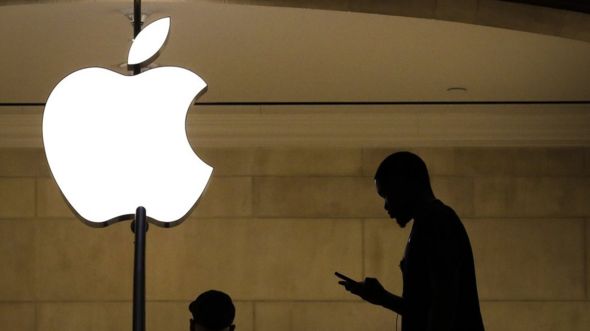
Image copyrightGETTY IMAGESImage captionThe global smartphone market is contracting
Apple boss Tim Cook has hinted it could lower iPhone prices in some places in an attempt to boost falling sales.
Revenue from the iPhone, responsible for most of the firm's profits, fell 15% in its latest financial quarter.
Overall the firm's revenue was down 5% from a year ago to about $84.3bn (£64.5bn).
The slowdown had been expected after the tech giant warned investors earlier this month that revenue would be about $84bn, lower than expected.
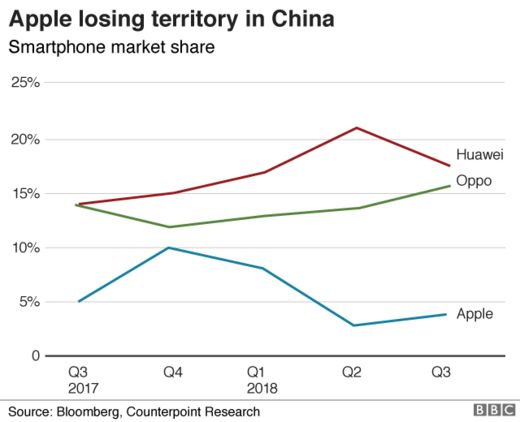
The firm had blamed the issues partly on an economic slowdown in China But chief executive Tim Cook said customers were are also struggling with the firm's high prices.
He said a strong dollar, which makes its products comparatively more expensive, has hurt its sales in emerging markets.
Mr Cook said the tech giant had started this month to re-pricing its phones to shield customers from the impact of currency fluctuations.
"What we have done in January in some locations and [for] some products is essentially absorb part or all of the foreign currency move as compared to last year."
Still, executives said they expected the firm's challenges to continue.
Apple predicted revenue in the three months to 31 March of $55bn-$59bn - suggesting a drop of at least 3.4% year-on-year.
"The macroeconomic environment, particularly in emerging markets, will continue to be there," Luca Maestri, the firm's chief financial officer, said.
Apple's struggles are not unique. Global smart phone shipments contracted 5% in 2018, according to Canalys, a market analyst firm.
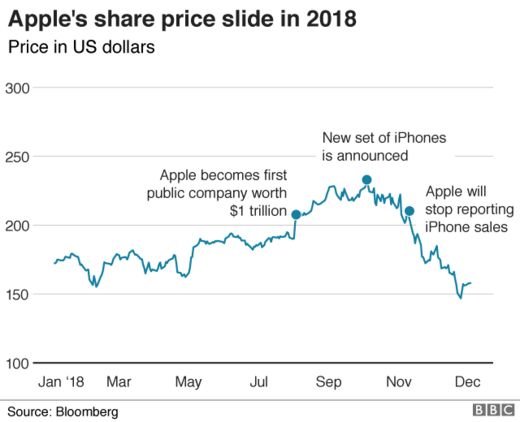
But the firm's share price has dropped by around one third since October, amid investor concerns that buyer appetite for iPhones is weakening.
Fears intensified after the firm said it would stop reporting the number of iPhones, iPads and Macs it sold each quarter.
However, Apple shares gained more than 4% in after-hours trade on Tuesday, as the firm proved more resilient than expected.
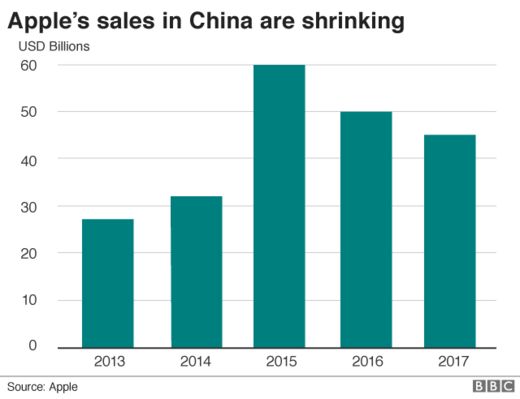
Quarterly sales revenue dropped by more than 25% in its Greater China region, which includes Hong Kong and Taiwan, compared to the year before.
Sales also slipped about 3% year-on-year in Europe.
But in the Americas - the firm's single biggest region - sales were up almost 5%.
Revenue from the services business also jumped 19% to a record $10.9bn in the quarter, which ended on the 31 December.
Image copyrightREUTERS
Analysis - Dave Lee, BBC North America technology reporter, San Francisco
It's Apple's worst performing quarter for years, but that's not to say investors won't be mildly relieved.
After the firm's warning earlier this month that it would be posting earnings well below expectations for what is typically its blockbuster quarter, investors were well-prepared to see the drop in iPhone sales, and as a result, revenues overall.
That bad news was balanced out - perhaps even cancelled out - by the good news on services.
A big increase compared to this time last year - 19% - and a very healthy gross margin of 62.8%.
Apple is transitioning, slowly, into a different kind of company that isn't so reliant on hardware, and these numbers show that so far that transition is going well.
With $245bn in case on hand, it can afford to splash out and make investors even happier with a major acquisition or two in the entertainment space (but then, I've been saying that for a while now!).
Mr Cook said he remained confident in the business, pointing to strong sales of iPad and Macs, as well as growth in its services division, which includes Apple Pay.
Overall profit in the quarter fell less than 1% to $19.97bn.
"While it was disappointing to miss our revenue guidance, we manage Apple for the long term, and this quarter's results demonstrate that the underlying strength of our business runs deep and wide," he said.
The video games sector now accounts for more than half of the UK's entire entertainment market, according to a new report.
The industry is worth £3.86bn ($4.85bn) - more than double its value in 2007 - said the Entertainment Retailers Association (ERA).
That makes it more lucrative than video and music combined.
The success is largely down to three games: Fifa 19, Red Dead Redemption 2 and Call of Duty: Black Ops 4.
The games market has grown, despite the fact that the physical console and PC games market shrank slightly in 2018, and digital also had a modest 12.5% growth.
Chief executive of ERA, Kim Bayley said: "The games industry has been incredibly effective in taking advantage of the potential of digital technology to offer new and compelling forms of entertainment. Despite being the youngest of our three sectors, it is now by far the biggest."
To get latest update of tech news through your WhatsApp kindly join our WhatsApp group through the link https://chat.whatsapp.com/LdpLR4Gh3ZrANvkgZBsSBx
Plant collectors have searched for the hidden wonders of the plant world for centuries.
Yet plants that are new to science are still being described, at a rate of about 2,000 a year.
Scientists at the Royal Botanic Gardens, Kew, discovered and named more than 100 new plants in 2018.
Their list of the top new plants includes carnivorous pitcher plants, exotic orchids and climbers with untapped medicinal powers.
Herb found in a waterfall
Prof Aiah Lebbie discovered an unusual plant clinging to rocks near a water fall in Sierra Leone. He collected a specimen and sent it to Kew, where it was identified as a new species. The plant, Lebbiea Grandiflora, has been named after him.
Image copyrightRBG KEWImage captionAn aquatic herb found in a waterfall in the Sewa River
"It's got unique characteristics, that are unlike any other plant in that particular family and that straight away indicated to me that we had come across something very unique," he told BBC News. "My name will forever be linked to it."
The plant has been classed as critically endangered. Found in an area that is under threat from mining and a hydro-electric project, the scientists believe it may be extinct within a few years.
It is thought that fish feed on the plants, strengthening the health of the ecosystem.
"Every single species of plant on earth is also important for our survival," said Prof Lebbie, of the National Herbarium of Sierra Leone.
"If we say we are not going to be custodians or guardians of it and allow them to disappear, for me that is something the world has lost, and as of now we don't even know the value of it."
Bug-eater from a remote island
There are more than 150 species of pitcher plant in the world. This new discovery, Nepenthes biak, only grows on the small island of Biak, off the north coast of Indonesian New Guinea.
Image copyrightMARTIN CHEEK, RBG KEWImage captionCarnivorous pitcher plant from New Guinea
It is threatened by tourism when ships stop at the island. "It's known that the plant has been hunted to be dug up from the wild for sale to passing tourists," said Kew botanist, Dr Martin Cheek. "Unless something is done about protecting this species it's heading for extinction."
It is our job to protect these plants for future generations to appreciate, he said. Pitcher plants, known as Nepenthes, have a number of potential uses in medicine, which have yet to be fully explored.
They are finding new things in plants all the time, Lara Jewitt, nurseries manager at Kew, said. "We never know what we are going to discover within these plants."
Flower that could be a future cancer medicine
The new plant, named Kindia gangan, is a member of the coffee family. Kew scientists on a field trip spotted it growing on sandstone cliffs near the town of Kindia in Guinea in West Africa.
Image copyrightMARTIN CHEEKImage captionA plant related to coffee
Biological extracts suggest the plant may have medicinal applications, perhaps even anti-cancer properties.
Orchid on sale after being smuggled out of the wild
A spectacular orchid was found being sold off the back of a barrow in Vientiane, the capital of Laos. The slipper orchid, Paphiopedilum papilio-laoticus, is gravely endangered.
Image copyrightADUNYADETHLUANGAPHAYImage captionSlipper orchid from Laos
Yam identified from an old photo
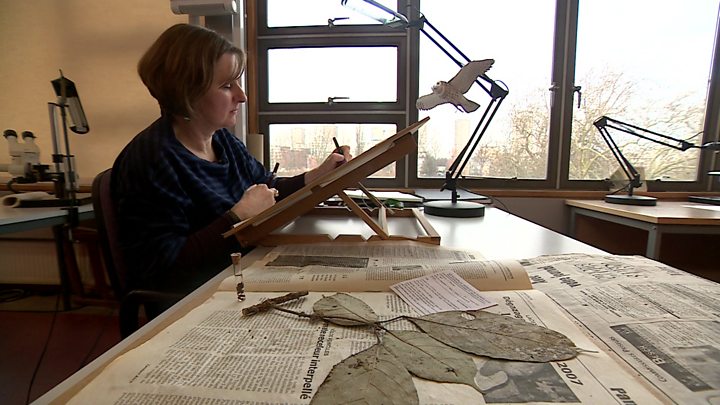
The climbing yam - a food crop in many parts of the world - was initially seen in a photograph sent to Kew in 2002. More than a decade later, pressed, dried specimens in Kew's herbarium were found to be a match.
The purple-flowered plant, Dioscorea hurteri, is found in six locations in KwaZulu-Natal in South Africa. It is classed as vulnerable to extinction.
Image copyrightGARETH CHITTENDONImage captionA climbing yam from South Africa
Vibrant flowering plant from Vietnam
This brand new species, Oreocharis tribracteata, was seen on an expedition to northern Vietnam. It was subsequently grown in the UK.
Image copyrightSADIE BARBERImage captionBright-orange-flowered plant from Vietnam
Tree from the rainforest
This large tree was seen growing in a rainforest in Guinea, West Africa. In the spring it has shocking pink flowers. Talbotiella cheekii was unknown to science until 2015.
Image copyrightMARTIN CHEEKImage captionA rainforest tree from Guinea
Wild spice tree
Image copyrightTHAISVASCONSCELOS3Image captionA new tree from the spice family
This tree, Pimenta berciliae, is related to the tree that brings us Allspice, a vital ingredient in food and beauty products.
Flowering plant from the cloud forest
This plant with pink flowers was found in a valley in Bolivia.
Image copyrightMT MARTINEZImage captionA flower from the valleys of Bolivia
Tree feared extinct
One tree from Cameroon, Vepris bali, is known to grow only in a forest reserve in the Bamenda Highlands. It is thought to be extinct already due to habitat destruction.


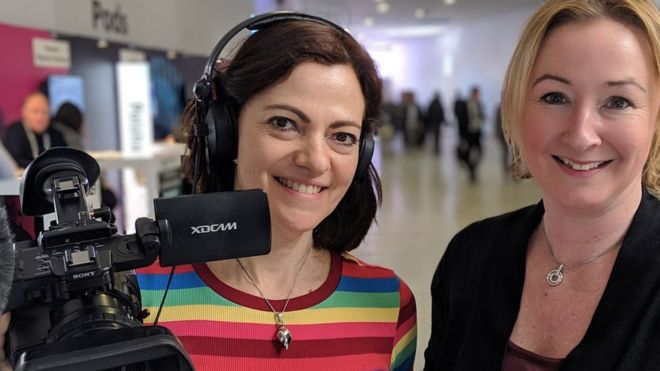 BBC colleagues Zoe Kleinman and Tracey Langford